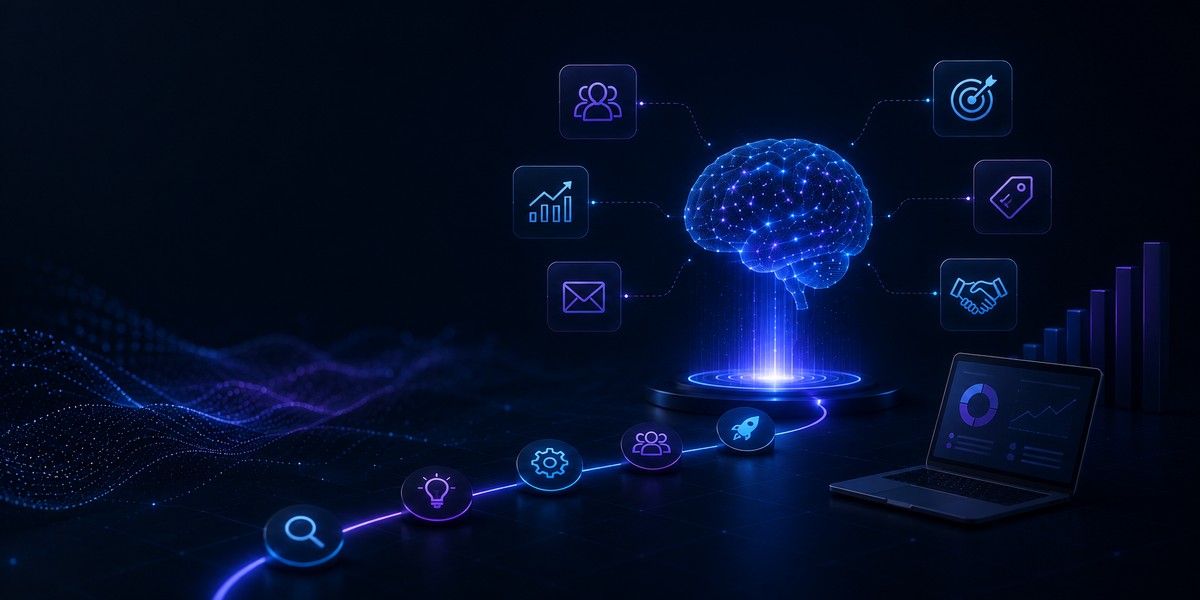

Top AI Trends Every CEO Should Know in 2026
AI is no longer just an IT conversation. It is a boardroom conversation. This guide breaks down the top AI trends every CEO must understand in 2026, from autonomous agents reshaping operations to AI governance becoming a competitive advantage.
By Aakash Kumar · · 13 min read

There is a story making rounds in India's startup circles about a founder who built one of the country's fastest-growing logistics platforms. In early 2024, his team proposed integrating an AI-powered route optimization system. He said they would revisit it the following quarter. There were bigger priorities.
Six months later, a competitor he had never taken seriously launched with AI at its core. Route efficiency was dramatically better. Delivery costs were lower. Customer satisfaction scores were higher. Within a year, the competitor had eaten a meaningful slice of the market.
The founder did not make a technology mistake. He made a timing mistake. He underestimated how quickly AI was moving from "interesting experiment" to "operational necessity."
In 2026, that mistake is no longer recoverable in six months. The gap between companies that have embraced AI at the leadership level and those that are still "exploring it" is widening every quarter. This blog exists to make sure you are on the right side of that gap.
These are the AI trends for CEOs that define the competitive landscape right now.
Why AI Literacy Is Now a Leadership Requirement
For most of the past decade, CEOs could delegate AI decisions to their CTO or Head of Data Science. The technology was complex, the business cases were often unclear, and the risks were manageable enough that technical teams could own the agenda.
That delegation model is broken now.
AI decisions in 2026 are not purely technical decisions. They are strategic decisions about which parts of your business to automate, which talent to retain versus replace, how to position your product in a market where competitors are moving fast, and how to communicate with customers and regulators about the AI systems you deploy.
None of those decisions can be fully delegated. They require a CEO who understands enough about AI to ask the right questions, challenge assumptions, and own the outcomes.
This does not mean every CEO needs to understand gradient descent or transformer architecture. But it does mean understanding the trends well enough to know what is real, what is hype, and what demands immediate attention.
That is exactly what the rest of this guide delivers.
Trend One: Agentic AI Is Replacing Workflows, Not Just Tasks
For the past few years, AI was mostly used to speed up individual tasks. Draft this email faster. Summarize this document. Generate this image. The human still managed the workflow. AI just helped at specific moments.
Agentic AI changes this fundamentally.
An agentic AI system is not a tool that helps humans complete tasks. It is a system that takes an objective, breaks it down into tasks, assigns those tasks to the right AI agents, monitors progress, handles exceptions, and delivers outcomes with minimal human involvement.
Imagine your company's entire sales prospecting process: researching leads, personalizing outreach, scheduling follow-ups, qualifying interest, and handing warm leads to human sales staff. An agentic AI system can handle all of that autonomously. The human only enters the picture at the point of genuine relationship-building.
For CEOs, the implication is significant. The question is no longer "which tasks can AI help with?" It is "which workflows should we redesign around AI from the ground up?"
Companies that answer this question well will see cost structures and output quality that were previously impossible to achieve simultaneously.
TechTose's AI development practice helps businesses design exactly these kinds of agentic systems, starting from workflow mapping and ending with production-grade autonomous pipelines.
Trend Two: AI Is Entering the C-Suite Itself
This one surprises most people when they first hear it, but it should not.
The same AI capabilities that help sales teams prospect, help marketing teams generate content, and help developers write code are now being applied to executive decision-making. AI systems are being used to model strategic scenarios, analyze competitive moves, forecast market shifts, and synthesize intelligence from dozens of data sources into executive briefings.
Companies like Microsoft, IBM, and several well-funded startups are building what some are calling "AI co-pilots for the C-suite": systems that surface the information leaders need, model the consequences of major decisions, and flag risks before they become crises.
This does not mean AI is replacing CEOs. It means the most effective CEOs will increasingly be those who know how to use AI as a thinking partner for the decisions that only humans can ultimately make.
The CEO who asks their AI system "what are the three scenarios we should prepare for if interest rates rise by another percentage point?" and gets a well-structured, data-grounded answer in seconds has a genuine advantage over the CEO who waits three weeks for an analyst to produce the same output.
Trend Three: The Rise of Industry-Specific AI Models
The first wave of enterprise AI was dominated by general-purpose models. GPT-4, Gemini, Claude, and similar systems could handle almost any task reasonably well because they were trained on broad, general data.
The second wave, which is well underway in 2026, is all about specialization.
Healthcare-specific AI models are trained on clinical data, medical literature, and patient records. They make far more accurate diagnoses, treatment recommendations, and drug interaction assessments than general models.
Legal AI models are trained on case law, contracts, regulatory filings, and precedent. They draft and review documents with a precision that general models cannot match.
Financial AI models understand market dynamics, risk frameworks, and regulatory requirements in ways that make them trustworthy in compliance-sensitive environments where a general model's confident-sounding errors would be catastrophic.
For CEOs, this trend means that "which AI tools should we use" is increasingly the wrong question. The right question is "what specialized AI is being developed for our specific industry, and are we deploying it faster than our competitors?"
Companies that continue using general-purpose AI while competitors deploy specialized models will notice the gap showing up in output quality, error rates, and customer outcomes.
Trend Four: AI Governance Is Becoming a Boardroom Priority
Every powerful technology eventually produces a governance conversation. We saw it with data privacy after Cambridge Analytica. We saw it with social media after questions about algorithmic influence. We are now seeing it with AI, and this time the regulatory response is moving faster than it ever has.
The European Union's AI Act is now being actively enforced. India is developing its own AI regulatory framework. Sector-specific AI regulations are emerging in finance, healthcare, and education across dozens of jurisdictions.
For CEOs, this means AI governance is not a compliance department problem. It is a board-level risk conversation.
The companies that will navigate this well are not the ones scrambling to comply after regulations are imposed. They are the ones building responsible AI practices proactively: clear documentation of how AI systems make decisions, bias auditing processes, transparency mechanisms for customers who interact with AI, and human oversight frameworks that prevent autonomous systems from causing harm.
There is also a competitive angle here that often gets overlooked. Customers, enterprise buyers, and institutional investors are increasingly asking "how does this company govern its AI?" Companies that can answer that question well earn trust that translates directly into business outcomes.
Treating AI governance as a moat rather than a burden is one of the most strategic decisions a CEO can make in 2026.
Trend Five: Generative AI Is Transforming Customer Experience
The era of generic, template-driven customer experience is ending. Generative AI is making it economically feasible to create personalized experiences at a scale that was previously only available to the largest companies in the world.
An e-commerce platform powered by generative AI does not show every customer the same product recommendations. It generates a unique browsing experience based on each customer's history, preferences, context, and intent.
A financial services app powered by generative AI does not give every user the same savings advice. It generates personalized guidance that factors in the user's income pattern, spending behavior, goals, and risk tolerance.
A SaaS platform powered by generative AI does not have a static help center. It has a conversational support system that understands each user's specific configuration and answers questions in the context of exactly how they are using the product.
The customer experience implications for every industry are enormous. And the CEOs who grasp this are already working with their product teams to redesign customer journeys from the ground up with generative AI as an enabling layer, not an add-on feature.
This connects directly to how UI/UX design philosophy is evolving at TechTose, where designing for AI-personalized experiences requires rethinking the entire information architecture of a product.
Trend Six: AI and the New Shape of Software Development
Software has always been expensive to build and slow to change. AI is fundamentally altering both of those realities.
AI-assisted development tools are now helping engineers write, review, test, and document code dramatically faster than before. But the more significant shift is happening at the architectural level. AI is making it possible to build more modular, adaptable software systems where components can be updated or replaced without disrupting the whole.
For CEOs, this has a direct business implication. The competitive advantage of having "better technology" used to require years of development investment. In 2026, a company with smart AI integration in its development process can close a technology gap that would previously have taken years in a matter of months.
This also means that technology debt, the accumulated cost of decisions made under pressure in past years, is less of a permanent disadvantage than it used to be. AI-accelerated development creates genuine opportunities to modernize legacy systems at a pace and cost that was not achievable before.
The web development and custom software development teams at TechTose have embedded AI-assisted development workflows into their process, delivering faster iteration cycles and cleaner codebases for clients across industries.
Trend Seven: The Human-AI Workforce Is Here
The debate about whether AI will replace human workers is, at this point, less productive than understanding what the human-AI workforce actually looks like and how to design it well.
The reality in 2026 is that most knowledge work roles are being redesigned around AI tools. Analysts use AI to process data they could never have reviewed manually. Writers use AI to research, structure, and refine content at higher volume. Customer service teams use AI to handle routine queries while focusing human attention on complex, emotionally sensitive interactions. Developers use AI to handle boilerplate work while concentrating their skill on architecture and problem-solving.
The companies that are doing this well are not simply giving employees AI tools and calling it transformation. They are redesigning job roles to reflect what humans do distinctly well: judgment, relationship-building, creative problem-solving, and ethical decision-making. And they are being intentional about what AI handles so that human cognitive capacity is directed at the highest-value activities.
For CEOs, the urgent questions are: what does each function in my organization look like when AI handles the routine work? What new skills do my people need? Where are we being slowed down by manual processes that AI could automate today?
Trend Eight: AI Is Rewriting the Rules of Competitive Advantage
Traditional competitive advantages were built on scale, access to capital, distribution networks, or proprietary data. These advantages took years or decades to build and were correspondingly hard to disrupt.
AI is compressing the timeline for building and disrupting advantages in ways that change the strategic landscape significantly.
A startup with the right AI stack can operate with the efficiency of a company ten times its size. A company that has spent years accumulating proprietary data suddenly has the ability to extract unprecedented value from that data through AI analysis. A business with a strong customer relationship can now deliver personalized value at a scale that was previously only possible with much larger teams.
At the same time, advantages that seemed durable are becoming fragile. A company whose competitive position depended on information asymmetry, knowing things about markets or customers that competitors did not, is vulnerable to competitors who use AI to close that information gap quickly.
The CEOs who are thinking most clearly about this are asking a fundamental question: in an AI-enabled market, what does our sustainable advantage actually rest on? The answers are typically some combination of proprietary data, brand trust, and unique human expertise. Everything else is increasingly replicable.
Trend Nine: Edge AI Is Bringing Intelligence to the Physical World
Most of the AI conversation focuses on cloud-based systems accessed through software. Edge AI is something different, and it is quietly becoming one of the most significant technology trends for industries with physical operations.
Edge AI refers to AI models that run directly on devices, sensors, and machines rather than in centralized cloud servers. The intelligence is embedded in the physical world.
A manufacturing facility where quality control AI runs directly on cameras on the production line, catching defects in real time without sending data to the cloud. A retail store where inventory management AI runs on local hardware, adjusting shelf recommendations instantly. A logistics fleet where route optimization runs on the vehicle itself, adapting to traffic without relying on a constant internet connection.
For CEOs in manufacturing, retail, healthcare, agriculture, or logistics, edge AI represents an opportunity to bring intelligence to parts of the operation that cloud-based AI simply cannot reach reliably.
India's manufacturing sector, which is experiencing significant growth driven by policy tailwinds and global supply chain restructuring, is particularly well-positioned to benefit from edge AI adoption in the coming years.
Trend Ten: The Cost of AI Is Dropping Faster Than Anyone Expected
This may be the most practically important AI trend for CEOs who are still on the sidelines thinking AI is too expensive to deploy at meaningful scale.
The cost of running AI inference has dropped by roughly an order of magnitude in the past two years. This is driven by better model architectures that achieve strong performance with fewer parameters, dedicated AI hardware becoming more accessible, increased competition among cloud providers, and open-source models that deliver near-frontier performance for free.
What this means practically: AI capabilities that cost significant sums to run in 2023 are now economically deployable for mid-size and even small businesses. The cost barrier that kept AI as a large enterprise privilege is crumbling.
This trend is accelerating. As models become more efficient and hardware continues to improve, the question of AI ROI for businesses is shifting from "can we afford to deploy AI?" to "can we afford not to?"
For companies working with TechTose on mobile app development and digital product builds, this cost reduction means AI features that were previously budget-constrained are now well within reach for projects at almost any scale.
How Competitors Are Framing AI Trends for Business Leaders
The conversation about AI trends for CEOs is not new, and several major publications and consulting firms have staked out positions in this space worth knowing.
McKinsey Global Institute produces quarterly AI trend reports that are authoritative and data-rich but tend toward dense, consultant-friendly language that requires effort to extract actionable insight from.
Gartner's Hype Cycle is the most cited framework for tracking AI maturity but focuses heavily on where technologies sit in a maturity curve rather than what CEOs should actually do with that information.
Harvard Business Review covers AI leadership with strong editorial quality and real executive case studies, though articles tend to be short-form and rarely go deep enough on implementation.
Deloitte Insights publishes an annual State of AI survey that is one of the most comprehensive data sources on enterprise AI adoption, though it skews toward large enterprise context.
BCG's Henderson Institute frames AI through the lens of competitive strategy with strong conceptual thinking, but the content can feel abstract for operators focused on immediate decisions.
MIT Sloan Management Review is one of the most rigorous publications covering the intersection of AI and leadership, with a strong focus on evidence and long-form analysis.
PwC's AI Predictions report is annual and broad-based, useful for benchmarking where industry peers stand on adoption but lighter on strategic guidance.
Accenture Technology Vision takes a forward-looking approach to AI trends with strong investment in visual presentation and executive storytelling, though depth varies across topics.
World Economic Forum's AI reports cover AI from a global governance and societal impact perspective, which is important context but not always immediately actionable for business leaders.
Forbes Technology Council provides practitioner perspectives on AI trends through contributed articles, with high variation in quality but occasionally very practical insight.
What most of these sources share is a tendency to cover AI trends at altitude. What TechTose brings differently is a perspective grounded in actually building AI-powered products, not just observing and reporting on the market.
What CEOs Who Get It Right Are Actually Doing
After working with businesses across industries, the TechTose team has observed a consistent set of behaviors among the CEOs who are getting the most value from AI.
They have appointed clear internal ownership of AI strategy. Not delegated entirely to the CTO, but with genuine executive sponsorship at the CEO level and a cross-functional team responsible for translating AI opportunity into business outcomes.
They are running focused pilots before committing to full deployment. Rather than trying to transform the entire organization at once, they pick one high-impact workflow, deploy AI thoughtfully, measure the results rigorously, and use the learnings to guide expansion.
They are investing in their own AI literacy alongside their team's. Reading, attending briefings, using AI tools personally, and building genuine familiarity with what these systems can and cannot do.
They are thinking about data as a strategic asset that becomes more valuable as AI capabilities improve. Businesses that have been diligent about collecting, organizing, and governing their data are in a dramatically stronger position to extract value from AI than those whose data is scattered and inconsistent.
And they are choosing technology partners who understand AI deeply, not just vendors who have added "AI" to their marketing language.
If you want to understand how TechTose helps CEOs and product leaders build AI into their businesses with clarity and confidence, the insights library is a good place to start, with deep guides on everything from how AI models actually work to using AI for smarter keyword research and converting digital traffic into real revenue.
When you are ready to move from understanding to action, schedule a conversation with TechTose and let's map out what AI can do for your business specifically.