

DeepSeek AI vs. ChatGPT: How DeepSeek Disrupts the Biggest AI Companies
DeepSeek AI’s cost-effective R1 model is challenging OpenAI and Google. This blog compares DeepSeek-R1 and ChatGPT-4o, highlighting their features, pricing, and market impact.
By Aakash Kumar · · 7 min read
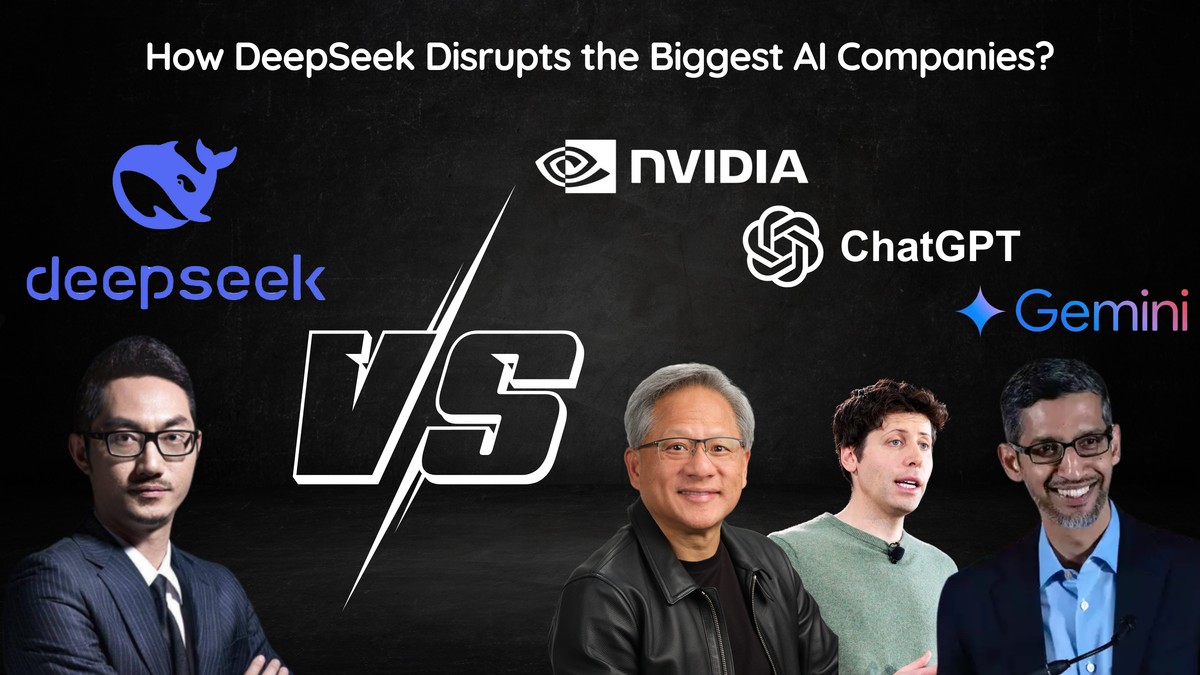
Artificial intelligence is evolving rapidly, and a new player, DeepSeek AI, has emerged as a formidable challenger to industry giants like OpenAI, Google, and Nvidia. Founded in 2023 by Liang Wenfeng, DeepSeek AI has gained attention for its cost-effective yet powerful AI models. This breakthrough has sparked a stir across the global tech industry, with its efficient use of resources and open-source approach challenging the status quo. The release of DeepSeek's AI model even caused Nvidia's market value to plummet by $593 billion, a sign of the seismic impact this development has had.
But how does DeepSeek’s R1 model compare to OpenAI’s GPT-4o, and why has it caused turbulence in the tech industry? Let’s explore DeepSeek’s rise, its impact on the AI landscape, and how it’s challenging some of the biggest tech companies in the world.
DeepSeek R1 vs. ChatGPT: A Battle of Innovation and Cost-Effectiveness
DeepSeek AI’s R1 model is its latest innovation, providing free AI services while offering capabilities comparable to OpenAI’s GPT-4o. This development has positioned DeepSeek as a major disruptor in the AI industry.
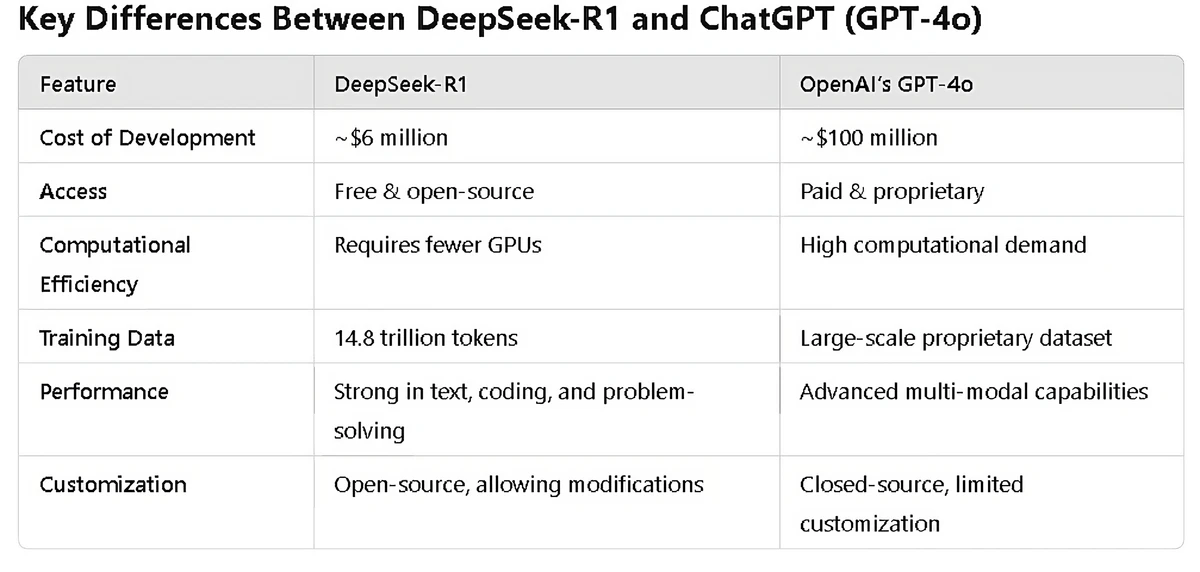
DeepSeek’s cost-efficient approach challenges the high-budget AI models developed by OpenAI, Google, and Meta. By leveraging Multi-head Latent Attention (MLA) and Mixture-of-Experts (MoE) techniques, DeepSeek achieves high performance while using fewer resources.
While OpenAI’s GPT-4o integrates advanced multi-modal capabilities (text, vision, and audio), DeepSeek-R1 focuses on high-quality natural language processing and coding, making it a viable alternative for many AI applications.
DeepSeek-R1: A Game-Changing AI Model
DeepSeek's DeepSeek-R1 model has generated immense attention for its performance and cost-efficiency. Achieving results comparable to OpenAI’s GPT-4 but at a fraction of the cost, DeepSeek-R1's development represents a significant step forward. OpenAI’s GPT-4 is estimated to have cost around $100 million to train, whereas DeepSeek-R1 was developed with just $6 million
In terms of performance, DeepSeek-R1 excels in natural language understanding and generation, making it ideal for applications ranging from conversational agents to complex data analysis. The model processes vast datasets with impressive speed and generates human-like text with contextually relevant insights, showcasing its versatility across industries like finance, healthcare, and customer service.
Moreover, DeepSeek’s commitment to efficiency extends beyond cost savings. The company’s open-source approach allows developers to customize and adapt the AI to specific needs, fostering innovation and creativity. By combining high performance with affordability and flexibility, DeepSeek-R1 is positioned as a major contender in the AI landscape, disrupting the status
The Wide-Ranging Impact of DeepSeek on the Tech Industry
DeepSeek’s influence on the tech industry is multifaceted, with far-reaching effects in several key areas:
1. Enhanced Data Analysis Capabilities:
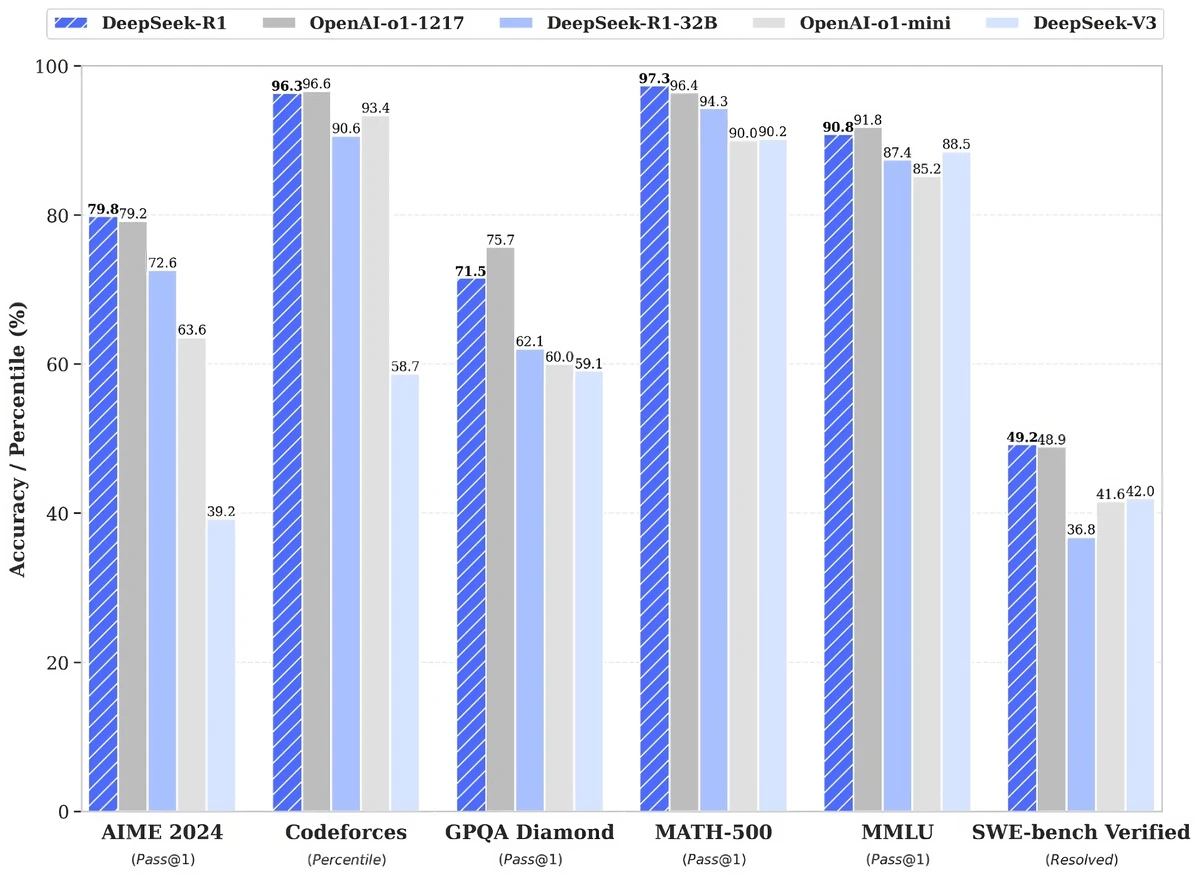
DeepSeek’s powerful algorithms have revolutionised data analysis across sectors. Its ability to identify hidden patterns and correlations has led to more accurate predictions and improved decision-making in areas like finance, marketing, and customer service.
2. Accelerated Research and Development:
DeepSeek’s technology is accelerating research in diverse fields, from genomics and drug development to climate modelling. The AI’s ability to automate complex data analysis allows researchers to focus on innovation and interpretation, driving breakthroughs faster.
3. Strengthened Cybersecurity:
DeepSeek's advanced anomaly detection algorithms are enhancing cybersecurity measures, identifying patterns indicative of cyber threats more efficiently than traditional methods. This enables quicker response times and more effective threat mitigation strategies.
4. Automation of Complex Tasks:
DeepSeek’s AI is streamlining industrial processes, automating tasks such as supply chain optimisation, customer service interactions, and more. By doing so, it boosts efficiency, reduces costs, and frees human workers to focus on higher-level tasks requiring creativity and critical thinking.
5. Driving Innovation in AI Development:
DeepSeek's techniques have furthered the development of AI, particularly in fields like deep learning, natural language processing, and computer vision. Its success in addressing challenging data analysis problems is prompting further innovation across the AI industry.
6. Ethical Considerations:
The power of DeepSeek’s technology also raises important ethical questions, including concerns about data privacy, algorithmic bias, and potential misuse. The industry is grappling with these challenges, focusing on developing robust ethical guidelines to ensure responsible AI deployment.
Market Reactions: Disruption and New Challenges
DeepSeek’s rapid rise has sent shockwaves through the AI and tech sectors, affecting the stock market and forcing major companies to rethink their AI strategies. Here’s how DeepSeek is challenging some of the world’s biggest AI firms:
1. Nvidia's Stock Drop
DeepSeek AI’s efficient use of fewer GPUs means reduced dependency on high-end Nvidia chips, impacting Nvidia’s revenue streams. Following the release of DeepSeek’s AI models, Nvidia’s market value dropped by $593 billion, reflecting investor concerns over declining GPU demand in the AI sector.
2. OpenAI and Google’s Competitive Pressure
OpenAI, backed by Microsoft, has dominated the AI industry with ChatGPT and GPT-4o, but DeepSeek’s free AI model has created new competition.
Google’s Gemini models, which have struggled with controversy and performance issues, now face added pressure as DeepSeek provides an alternative AI ecosystem.
3. Disrupting Elon Musk’s xAI and Tesla’s AI Efforts
Elon Musk’s xAI and Tesla’s AI initiatives are heavily reliant on Nvidia hardware and closed-source AI models. DeepSeek’s cost-effective and open-source approach could shift AI development trends away from proprietary systems, affecting Musk’s AI investments.
4. Shaking the US AI Market
DeepSeek’s rise signals China’s growing influence in AI development, challenging the US-based AI monopoly. This has led to increased scrutiny and geopolitical tensions over AI leadership. US AI companies, including Nvidia, OpenAI’s backers, and Google, have experienced stock fluctuations as investors reevaluate the AI landscape.
5. Increased AI Competition
Open-source AI models are democratizing access to AI, making it easier for startups and smaller companies to develop AI-powered solutions. DeepSeek has proven that AI models can be built at a fraction of traditional costs, forcing companies to rethink their expensive AI training methods
Open-Source Strategy: Benefits and Challenges
DeepSeek's decision to adopt an open-source strategy offers a range of benefits and challenges:

1. Accelerated Innovation:
Making the source code publicly available fosters a collaborative environment where developers worldwide can contribute to its improvement. This accelerates innovation, with the collective intelligence of the open-source community driving progress faster than in a closed-source model.
2. Increased Accessibility:
The open-source model removes financial barriers, allowing developers, researchers, and businesses of all sizes to leverage DeepSeek’s technology. This broadens the accessibility of advanced AI capabilities, fostering greater adoption and integration across sectors.
3. Transparency and Trust:
Open-source models are inherently more transparent, as the code can be independently audited for ethical issues and vulnerabilities. This helps build trust among users and ensures responsible deployment of the technology.
4. Ongoing Community Support:
The open-source community provides valuable support, troubleshooting, and feature enhancements. This shared responsibility reduces the burden on DeepSeek’s original developers, ensuring the long-term sustainability of the project.
5. Security and Intellectual Property Concerns:
The open-source model also presents challenges, such as the risk of malicious actors exploiting vulnerabilities and the protection of intellectual property. Balancing the benefits of collaboration with the need for security and IP protection is a continuous challenge.
6. Fragmentation and Standardisation:
As multiple developers contribute to the project, there is a risk of fragmentation, leading to compatibility issues across different versions. Establishing clear guidelines and standards within the community is essential to maintaining interoperability and consistency.
Shaping the Global AI Landscape: DeepSeek’s Long-Term Influence
DeepSeek’s emergence is reshaping the global AI landscape in several ways:
1. Shifting Power Dynamics:
DeepSeek’s open-source nature is challenging the dominance of traditional AI giants. By democratizing access to advanced AI, it empowers smaller companies and researchers to compete on a more level playing field, potentially decentralising AI development.
2. Accelerated Technological Advancements:
The global collaboration fostered by DeepSeek’s open-source model is accelerating technological advancements, with rapid improvements in algorithms, performance, and applications. This collaborative environment pushes the boundaries of AI capabilities.
3. Intensified Competition:
DeepSeek’s success has intensified competition in the AI space, motivating companies to invest heavily in R&D to stay ahead. This is driving the development of improved algorithms and more efficient hardware, leading to a wider range of AI solutions.
4. New Standards and Frameworks:
DeepSeek’s rise could lead to the development of new industry standards for AI, encouraging the creation of shared tools, libraries, and best practices. These frameworks would promote collaboration and efficiency, streamlining development processes.
5. Ethical and Regulatory Focus:
The widespread adoption of powerful AI technologies like DeepSeek necessitates a focus on ethical considerations and regulations. The open-source nature of DeepSeek makes it especially important to establish clear guidelines to mitigate risks like bias and misuse.
6. Geopolitical Implications:
DeepSeek’s success has geopolitical implications, particularly in reducing reliance on specific countries or companies for advanced AI. This decentralisation could alter the balance of technological power on a global scale.
Conclusion: DeepSeek’s Role in the Future of AI
DeepSeek AI has emerged as a major force in the AI industry, proving that high-quality AI models can be developed with minimal investment. By offering free access to its powerful AI, DeepSeek is not only disrupting big tech firms but also reshaping AI accessibility worldwide.As competition intensifies, the AI industry is set for major changes. Companies like OpenAI, Google, and Nvidia must adapt or risk being left behind. Meanwhile, DeepSeek’s open-source philosophy and cost-efficient technology make it a game-changer in the AI revolution.